

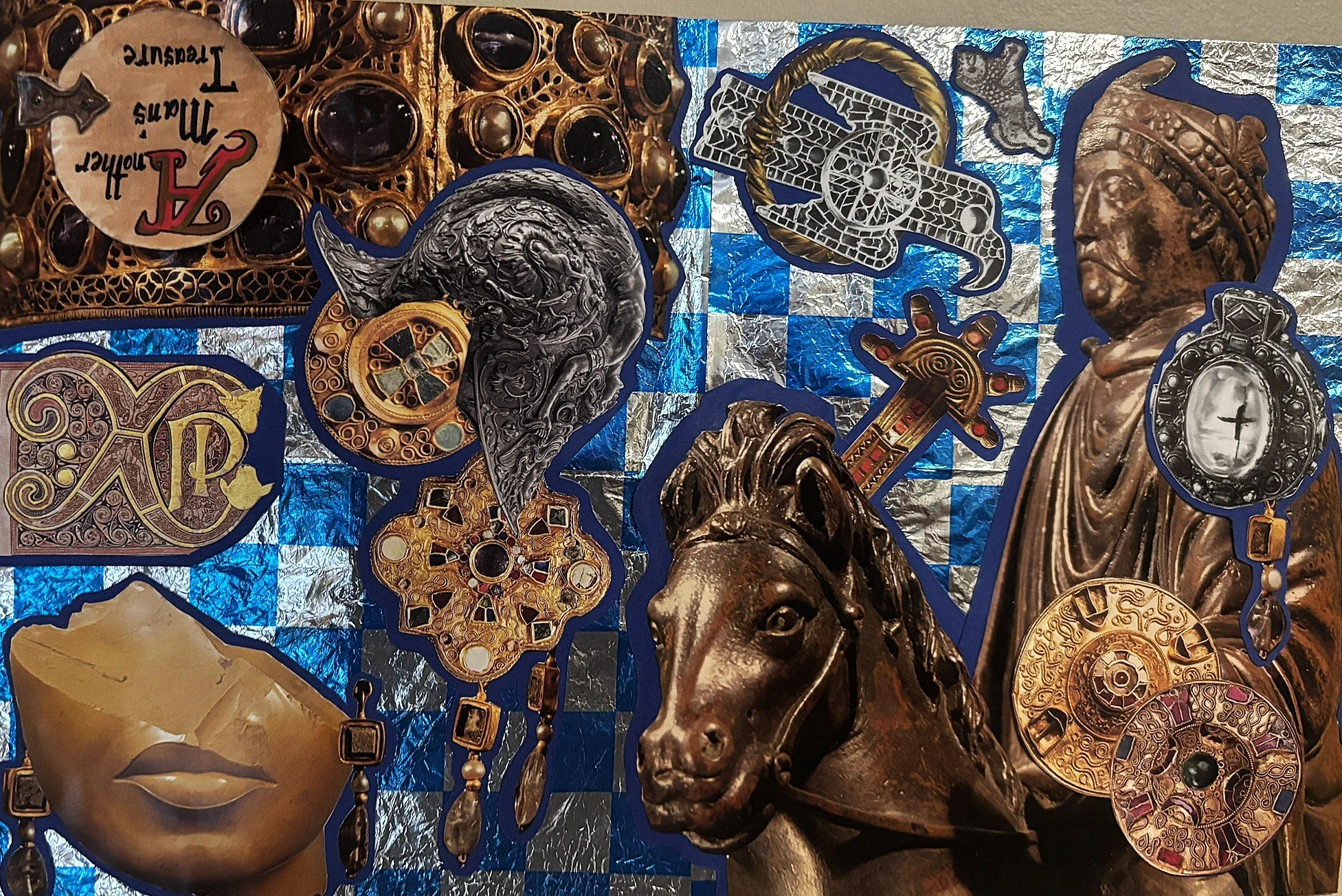
One Man’s Trash by Elizabeth Fitzpatrick
Issue 37.4
Editor’s Note
Dear Washington College Community—
The first piece I submitted to Collegian (way back in 2022) was a poem called “Behold the Humans.” I wrote it at around three in the morning during the summer before my freshman year, and my early-hour delirium and August-insomnia combined to make a poem so outstandingly and creatively mediocre that it hypnotized the editorial board into accepting it into the poetry section of Issue 34.1. “Behold the Humans” is now, as I’m writing this, closer to “Behold this Trash,” but still, Collegian was able to recognize the appeal of the poem even when I couldn’t. This process of recognition is something that Collegian has always done. As I finish up my last issue as editor in chief, I realize that this little literary magazine has always recognized artistic talent despite the doubts of the artist. This, I think, is what makes Collegian so special—it’s a site where doubts about the value and relevance of art are consistently disproven. As a freshman contributor, I felt the elation of having my poem accepted, and as a senior editor, I feel a similar excitement for those who will experience Collegian in the same way in the coming years, especially for Issue 38, of which the brilliant Leo De Luca will be leading. I am absolutely thrilled to pass the baton of leadership to Leo and to see where he takes Issue 38 of Collegian with his distinct style, intellect, and quiet attentiveness. I wish him and the next editorial team all the best.
That being said, this year’s issue of Collegian had a stacked line-up. Sophie Killbride, our managing editor, had a cool, calm energy that brought a casual fun to our editorial meetings. Jaya Basu’s exceptional intellect and understanding of poetry always left me astounded. Seth Horan’s thorough commentary and experience with editing prose were high-quality and always reliable. Ella Humphrey’s vibrant energy filled the Collegian office, and her artistic skill is undefeated. Eme Cummins, our social media manager, possesses an enthusiasm and amiability that instantly steadies and charms those around her. I am so glad to have built such an excellent issue with each of them. All of them go in the Collegian Hall of Fame.
The final issue of Collegian 37 offers its readers earthquakes, rivers, forests, and concrete seas. It illustrates goddesses, high winds, mental collapses, and forgotten antiques with abundant detail. Issue 37.4 asks readers to look twice, read twice, and recognize double meanings. Some parts of the issue will raise eyebrows, some will spook, others will soothe. Take it slow and take it in its entirety.
Thank you to all our contributors, submitters, and subscribers for taking your time with Collegian and for dedicating your attention to its pages, and thank you especially for trusting me to lead its process, people, and purpose well.
With love,
Sheri Swayne
Outgoing Editor in Chief of Collegian
Table of Contents
Evelyn Lee Lucado, “Pillow Princess Femme Pop”
Jeremy Cress, The Collapse of Sanity and Selection
Faye Dorman, “A Place You'll Never Return To”
Jessica Kelso, “San Andreas' Fault”
Jeremy Cress, Lost in the Wind
Savannah Nies, “my love and the living woods”
Ellie Bogue, “Billboard Model”
Elizabeth Fitzpatrick, Altar to Beauty
Stella Keeney, “Paving the Concrete Sea”
Melinda Kern, “Bridge Passage”
Elizabeth Fitzpatrick, “What's in a Name”
Christie Taylor, “Tidal Pool”
by Evelyn Lee Lucado
Pillow Princess Femme Pop
After “Stone Masc Jazz” by Jaya S. Basu
My roommate won’t stop telling the fruit flies in our kitchen
To kill themselves, and I can’t tell at this point if it’s joke or ritual,
The room smells like apple cider vinegar and the rotted half of a plum
I forgot on top of the microwave some time last week, browning and purpling––
Microscopic larvae erupt from the open, viscous, fleshy center— flies fuck
Like that’s all there is, and I wonder what it would be like to ask
My old Sunday school teacher what my body is worth aside from reproduction or,
I think I should say performance, the show of surrendering myself, hands above my head,
Sperm to ovum or finger to thigh, red waxed lips or covered shoulders—
Or maybe the performance of killing myself for the sake of a watery, baptismal rebirth,
Over and over–– Christ in Gethsemane screaming
‘Lord give me strength– make me whole– make me new– make me straight–’
I once asked my roommate what it means to be a gold star lesbian
And they said not to worry, that it doesn’t matter, but I do, and
I want to ask what purity I still hold if I allow a man to touch me––
If I want to be something untouched just to be touched by my choosing, and
Sometimes, I look in the mirror, and behind the cracking foundation of my peeling skin
I see that same moldering flesh that I left forlorn in the kitchen.
The flies follow me to the bathroom,
They fuck and whisper:
Kill yourself, kill yourself—
I think I’m ready to be something new.
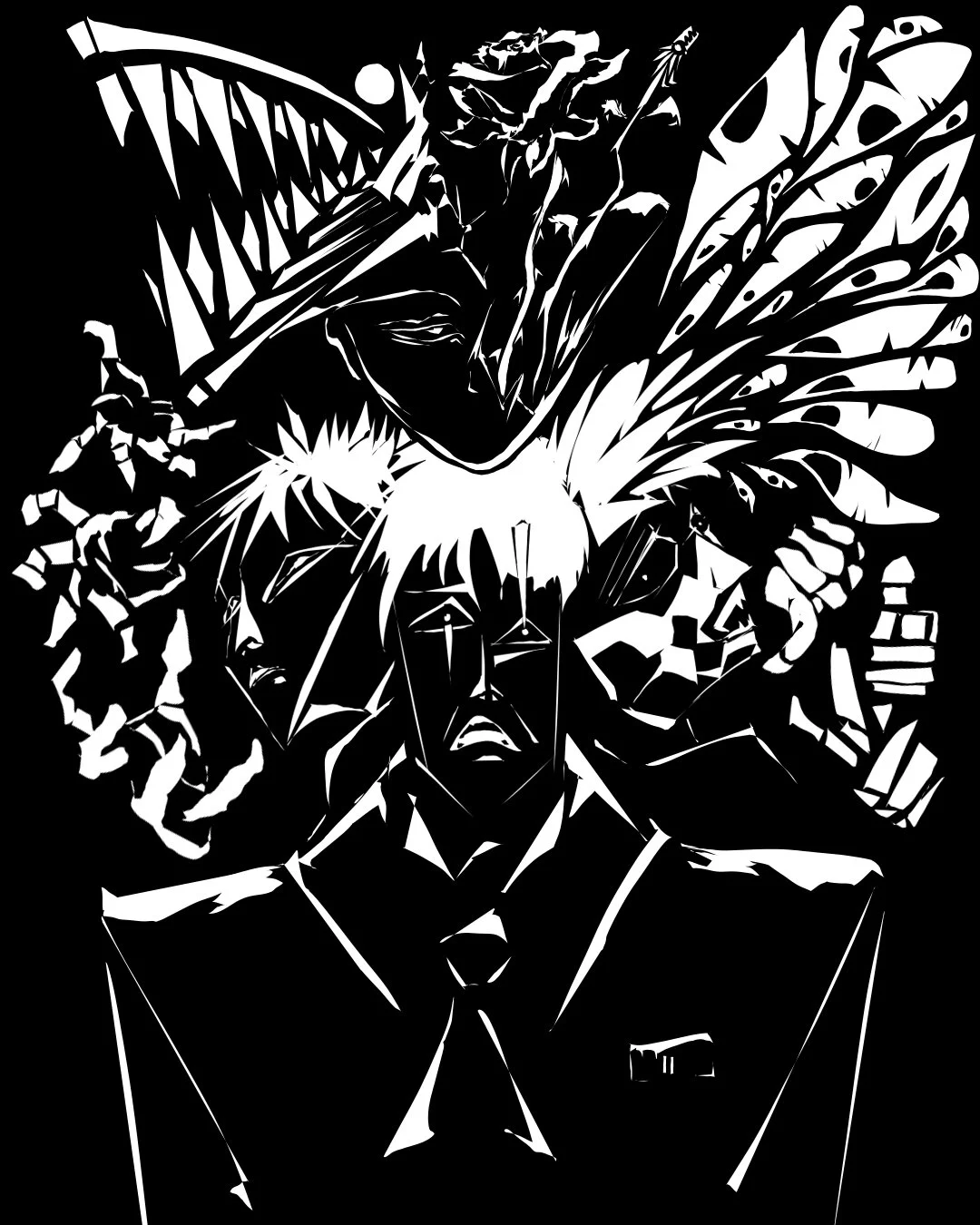
The Collapse of Sanity and Selection by Jeremy Cress
by Faye Dorman
A Place You’ll Never Return To
The river was never a river, but the way it coiled around her small town like an impassable barrier led the locals to call it such. It festered, quiet and dirty, at the bottom of a cavernous ravine of soft soil and dead roots, where it dampened rocks and limbs from the trees day in and day out, for as long as anyone remembered. Nothing ever happened, not that anyone could remember, but the river flowed the color of resentment, washing away the sparks of hope when they came; banks failed, houses rotted, bridges collapsed. For a time, it had kept the town enclosed, keeping everyone born there in and turning outsiders back out, the town slowly suffocating under the strain of isolation. But that time had long passed, and now there were bridges that could hold the weight of cars, bridges that stretched out over the riverbanks and out to greener pastures. Yet nobody left; like an old dog cut free from its chains, the people stayed, even as the river ate away at its ravine, inching closer and closer.
#
All she had ever known was this town. She lived in this town in houses with peeling paint and broken shutters and kicked in screen doors sewn up and stores with no cameras and sticking doors filled with cans and cans of all manner of delicacies you could find, and yet the people were starved and bloated with illness. In one shop, you would find canned peaches, however old they may be, and her daughter loved them. It made her uneasy, as all things in this place did, but maybe the mockery of fruit was better than the mockery of meat warming in the hot lights under a thin sheen of plastic. Her daughter had three of her fingers in the can, her pinky meticulously folded and out of the way, sticky and disgusting. Watching her daughter, her fingers gripped the wheel tighter, knowing that her backseats would be stained with the stickiness, a bloody handprint of a town’s corpse. It was not her daughter’s fault, but it still bothered her; such meticulous work to abandon every piece of furniture, clothing, and memento at her daughter’s grandparent’s house still wouldn’t leave her unscathed from this place. Maybe she should get a new car. Steadying herself, she looked away from the daughter she had stuffed between bags of belongings and life and focused on the road.
They would be nearing the bridge soon, never to return, never to reflect, never to regret; her daughter was too young to have a say in those matters anyway. The thought filled her with anticipation, leaving her fingers buzzing and her foot heavy on the gas as she spread her wings to take off. As the bridge came into view, the surrealness of it all wrapped around her head, occupying her mind until she could barely hear anything over her own blood pressure, just the sound of the tires changing as they spun onto the new surface, the sound of the window opening, the sound of the wind blowing through the car, the sound of rustling, her daughter screaming.
The car jerked under her fingers as she jolted back to herself, frantically straightening the wheel as her daughter began to wail in the backseat. There was no celebration after crossing the bridge, only a frantic movement to park the car on the side of the road. She spun, searching for blood and sharp objects and seeing that the window was open and that the pile next to the window was shorter by one object and that the look on her daughter’s face was guilt and the world stopped.
She rolled back over before opening the car door, placing one foot out then the other, looking up the road. There was a bridge and some trees and a ravine and the skid marks on the road and she knew, even if she didn’t want to. Gravel crunched beneath her feet and her daughter still cried in the backseat. The walk was short and soon she stood there, looking over the bridge, into the ravine, into the eyes of her doll, caught precariously on a rock sticking out of the water. The blue lace of her dress was damp on the hem, her blonde yarn hair falling out of her meticulously done pigtails, the tie for the left being pulled by the soft current. The doll was right there, where she could see her, where she could pick her up from the depths and hold her tight and fix her hair and dry her dress, and yet she knew she couldn’t.
The river didn’t just trap the town it surrounded; it trapped anything that would venture down to drink from its shores. Soft soil and dead roots fell away under fingers and paws alike, a silken siding too tall to climb and too dense to dig. There was nothing to be done for anything that went down there but let them wander in the coils until they collapsed and became the river’s bedding.
She knew this. Her hands itched to vault her over the guard rail despite it. She stood there as the sound of the sobbing got louder, a chorus. She looked back at the car, before looking back at the doll, and thought about how her aunt had lost her ring to the ravine days before she and her cousin were set to move away, about how her cousin set out for the ravine with empty eyes when his mom never came back. She remembered going out one night to the edge of the ravine to see if there was something remaining of her aunt, of her cousin, but all she found was a darkness that seemed to call for her by a different, older name.
Arthona, it had called. Arthona, it called to her, standing still on the bridge. She could almost see her aunt’s ring shining in the ripples. It was taunting her. It knew that no matter what she did, there would be a piece of her, buried in soft soil and dead roots and old forgotten family names. Worst of all, it knew how much she wanted it, how much she wanted to chase after this illusion of comfort, of familiarity. No matter how much she tries to distance them in her mind, her daughter’s grandparents are still her parents, and there’s a room painted pale pink with a worn-out mattress that would always be hers. But she thinks about that room, and how many days she spent lying there, unbothered by the rising and setting of the sun. How the sun peaked through her window the same way it peaked through the kitchen window when her mother stood at the sink. When her mother had told her that she had hidden all of her acceptance letters because it was dangerous and unnecessary to leave, told her that this place was home, no matter how bad it got.
Her hands had started to hurt from clutching the rail, but she held on a little while longer. She had willed her tears to stop, but her chest hadn’t quite received the message, leaving her hiccupping quietly. She straightened herself, then turned, walking across the bridge over the ravine to where her daughter sat in the backseat, too young to remember anything the ravine could take, and swore that she wouldn’t be the reason her daughter would have to stay.
by Jessica Kelso
San Andreas’ Fault
Pacific plate | North | American plate South
Saint Andrew was only a | man | has the power to destroy itself
Humanity seeks | preserved sanctuaries | stay pure
Los Angeles approaches | San Francisco | sinks
Civilization settled upon | strike-slip transform boundaries | do not build mountains or valleys
California moved five centimeters | this year | my hair grew eight inches
Parallel motion separates | cities | rebuild after disaster
Soon we will have | underwater graves | are where history lies
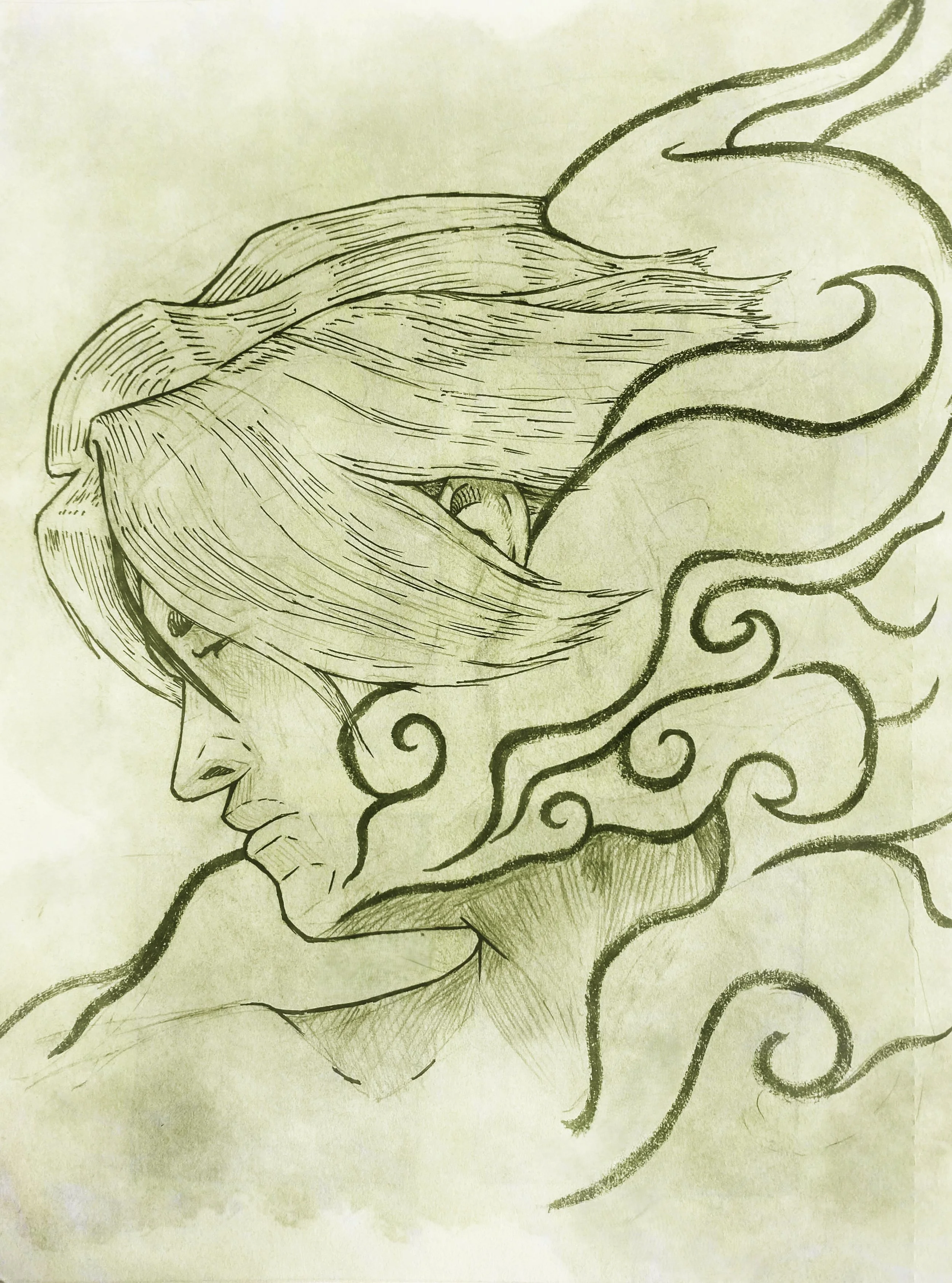
Lost in the Wind by Jeremy Cress
by Savannah Nies
my love and the living woods
your lipstick prints the metal of my harmonica—
ripping trickling riffs into the stars,
campfire shifting to sigh a column of smoke with the notes—
and we kiss to Cowpoke’s slow, rippling chords.
cool river water bubbles past our calves,
we scoop it up and press cupped palms to lips,
our slurping skips across the brook into the trees;
behind us, the sound of the windchimes back at camp rolls softly downhill.
fireflies alight under storm clouds,
tiny suns swimming in early summer thunder.
bare feet trip on sticks to the lake until, floating on our backs,
water laps our lips, cheeks, chests, naked to the nothing above, trembling.
whip-poor-wills and mourning doves and owls
trill through flickering leaves and tent sides,
songs spilling into our ears, dampening my dreams:
i saw you in a field, surrounded by sweet bay petals, and you said you loved me.
by E.T. Bogue
Billboard Model
A woman—a girl, really, only eighteen—loiters outside of a gas station in Texas. Her five-dollar sunglasses, rimmed in red plastic, are pushed to the top of her head. The hot wind blows her dark hair all about. She chews on spearmint gum. The actual flavor has long faded, but it’s her last piece and she’s reluctant to spit it out.
The girl watches cars pull in and out of the station. She watches them zoom along the rural highway. The smell of exhaust hangs heavy in the air. She hates it. The sun beats down and she hates that too. She hates a lot of things, this girl, and she’s never held back from voicing it. Her mother used to call her attitude unbecoming, which really means unattractive.
Her mother used to call her a lot of things, sweet and placid voice dripping with disdain. Her father never called her anything but her name, but he also supported her mother’s ban on wearing crop tops and told her to just ignore it when the boys in high school snapped her bra strap.
She had been so eager to get away from them and their guidelines for girlhood that somehow felt more oppressive than even the humid summer air. So, when some friends from school invited her to join them on a post-graduation road trip, she readily accepted. The girl had no way of knowing that two days into their adventure, Joe would try to take a shortcut down a dirt road and get stuck in the mud.
Joe and the others are still with the car now, waiting for the tow truck. The girl had refused to wait with them in the pit of mud and the cloud of biting flies. She’d gotten out and hiked back down the poorly maintained trail, back to the gas station they’d passed earlier, smacking her gum the whole way there.
Sweat trickles down her back. It makes her tank top stick to her skin. Her sneakers are caked in mud, and there are globs of it stuck to her shins that have hardened in the heat. She bends down and scratches at one until it flakes off. Grime worms its way beneath her nails and she sighs. The girl had tried to tell Joe it was a bad idea to take the dirt road, but he’d laughed and brushed her off and claimed he knew what he was doing.
Great job, she thinks, mouth pulling into a sneer. You fucking idiot.
Swearing was another habit her mother called unbecoming. Sophisticated women should only use backhanded compliments and strategically deployed glares of disapproval. And even those are primarily reserved for other women.
The girl brushes the hair from her face, lets the tension recede from her jaw muscles. She stares out at the trio of billboards looming across the road from the gas station. One’s an advertisement for a nearby barbeque joint called Hank’s. The name is emblazoned in big red letters above a plate laden with ribs. Beside it is another ad, this one for some local lipstick brand
called Daring by Daisy. It must have been put up recently, because the image is still glossy, unlike the Hank’s sign, which is wind-battered and faded. The girl cannot stop staring at it.
There’s a woman below the brand name, perhaps the eponymous Daisy, perhaps not. Her heart-shaped face is framed by thick, borderline-messy waves of brown hair. Her lips are, of course, painted a deep burgundy color. She looks out at the road, and the gas station, with enormous dark eyes. Her expression is probably meant to be sensual, but to the lingering girl, it just looks confident. Something in the tilt of her chin, the unflinching nature of her gaze. The girl knows in the back of her mind it’s most certainly staged, but it’s easy to ignore that truth when she’s so drawn to the woman’s assertive visage.
She thinks that the woman looks so different from her tightly wound mother, who detests bold colors and unsubtle makeup. The girl thinks that her mother would probably turn her nose up at this woman if they came face to face—she wouldn’t call her a slut, because that would be crass, but she’d certainly think it. But this woman, with her defiant stare, wouldn’t care about the standards of anyone’s parents, not even her own.
That’ll be me someday, she decides then and there. By ‘that’ she means confident, and unapologetic, and so far beyond the conditions her parents have set for being a woman worth respecting that they’ll fall into the deepest recesses of memory. And maybe she means she’ll someday have her visage on a roadside advertisement too; her thought process isn’t that concrete, but she isn’t opposed to the idea. Right now, she’s staring, starry-eyed, at her new roadside idol, and she’s so full of wanting she feels she might burst.
The girl shifts her weight from one foot to the other, about to head into the gas station. She’s just remembered she’s got a couple dollars in her back pocket, and she wants to see if there’s a fresh pack of gum. But before she does, she stares, once more, at the woman on the lipstick billboard and thinks again; that’s gonna be me.
It won’t be.
The girl walks inside. She never looks at the third billboard, the more ramshackle one several yards away from the two advertisements. Like the lipstick ad, it’s got a woman—no, not a woman, a girl, barely eighteen—on it. Her photograph is grainy.. Her hair is frizzy, her youthful face splotchy with freckles and acne, her eyes half closed as she beams like the sun. Beneath her picture are words. Only the top line, composed of big, blocky, black letters can be read from across the highway. Have You Seen Me?
She’s not the first girl to go missing from this area. She won’t be the last.
Soon another billboard will line this dusty stretch of highway, asking desperate questions of passing motorists. Soon another woman, with all the hopes and dreams her personhood entails, will be reduced to memory and an oft ignored photo.
But that is later. Right now, there is a girl in a gas station, buying spearmint gum and a tube of dark red lipstick, brimming with endless possibility.
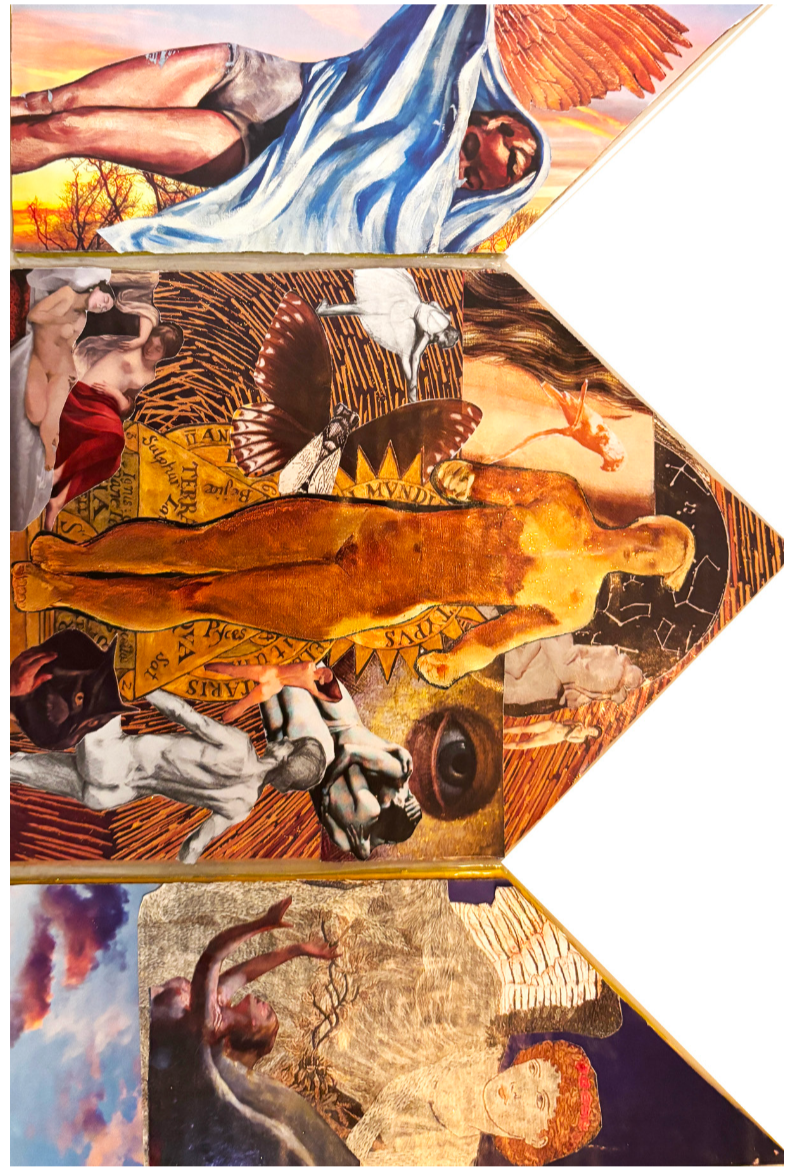
Altar to Beauty by Elizabeth Fitzpatrick
by Stella Keeney
Paving the Concrete Sea
I slip through the surface,
Submerging slowly into the softness.
The rocking waves carry me,
Pulling me forward and back, like a lover.
Unsure of whether to hold me close,
Or discard me without a second thought.
I plunge my face beneath the surf,
Feeling the tides overhead.
I begin to rise with the bubbles
Created by my dive.
One swift kick, then another.
My skull hits where the ocean’s skin is,
Where it’s supposed to release me to the sky above.
It is not the softness of waves and foam anymore,
It is concrete.
I cannot break through to the surface.
I will not be set free to breathe.
I look around desperately and my eyes catch on you.
And it is you,
Paving the concrete sea.
by Melinda Kern
Bridge Passage
Danni covers her face with long black hair with lime green ends in many of the pictures she posts. Her clothes are baggy, shorts always long to her knees, and everything black with accents of the same green dye in her hair. One rare recent photo featured her face: she was wearing a cap and gown, receiving her associates in World Language and Cultures from a local community college. Her oval face, makeup-cradled dark eyes, and warm bronze skin all complimented the ecstatic grin she gave in her graduation photos. She was excited to get a degree, more excited that the degree came with a pay raise at her Department of Defense job.
The other day, the newest photo on her social media was of her singing and playing a plain tan acoustic guitar. I wondered why she would go out to look at new ones when she already had one. “There was no music in the music shop,” she mentioned as she began to share the memory.
Danni and one of her other friends filled the guitar shop with voices little heard, and dreams set for the far-off future. Danni desperately wants to make a bilingual album in Chinese and English one day. “Specifically, it would be in Mandarin and English” she tells me interrupting her narrative to make sure I’m still on track. She continues, “there are other languages that would qualify as Chinese just as much––like Cantonese.” I knew this, but I didn’t bother interrupting.
The acoustic guitar she posted isn’t her own, but rather her dream guitar. It was in much better shape than the hand-me-down guitar from her dad. It didn’t hold any bad memories or broken strings. The shop owner allowed her to play and sing in the shop, and Danni’s friend snapped a photo with her Polaroid. The shop owner told the young women that “musicians filling the music shop with music of their own” is why he never played anything over the loudspeakers.
Walking across the dappled dark grey carpet with her younger but taller friend, Danni didn’t elaborate on her dream album. Her friend, also a Chinese adoptee to white American parents, didn’t need to ask follow-up questions on what the album would explore.
Before I had an opportunity to ask anything, Danni interrupted her own story to give space for my white ignorance.
“You know I like to write lyrics and play the guitar. I will always be my painting, my singing, all my 艺术 (yì shù). But I want to do more than just sing covers and post them to my socials. I want to make a bridge to others: Chinese adoptees, other Chinese American people, period––our neighborhood is so painfully white. 嗯 (ňg), I just want to build a community with friends, but also strangers I see at Super Best. I need to hear a bilingual album, so I’m making it. Do you get what I mean?” Danni said.
Quickly, I said yes with wavering thoughts. I didn’t want to get caught not understanding at once. I couldn’t look unsupportive in this moment of vulnerability. How different would it be if my ears could understand a wholly Mandarin explanation instead of an English one? I sat up straighter, focused, and silently listened.
The two friends looked at the many rows of guitars across the walls up to the ceiling in bright, bold colors and styles. Yet another picture posted to Danni’s social media story was a wall covered entirely with lime-green guitars (Danni’s second favorite color, only trumped by black). I looked back to this story photo afterwards, a little ashamed that I flitted past it the first time. Danni didn’t have the money to buy anything from the store that day, but she held onto hope of first being a musical artist, then retiring to become an 阿姨 (ā yí).
by Elizabeth Fitzpatrick
What’s In a Name?
There’s a magnet on our fridge. A yellow border frame with a preschool picture inserted into it. On the bottom it says: “Elizabeth: Oath of God.”
My mom’s cousin loves to buy presents, by which I mean: the most useless junk imaginable. Last summer, she got me a family crest Christmas ornament—not her family crest; mine. It comes with a little booklet that says: “Fitzpatrick: Mac Giolla Phadraig means ‘son of the servants of St. Patrick.’” She suggested I hang it on the rearview mirror in my car so I could appreciate it year-round.
My grandfather also has a family crest on his car keys. It’s his mother’s though: “Byrne,” not the name he inherited. He told me he doesn’t carry his—our—own crest so that if someone else found his lost keys then they wouldn’t be able to break into his house because they wouldn’t know who “Byrne” was.
I couldn’t help but think about this when it was suggested my gift be hung in the car.
My father likes a version of the story of our name he heard on one of those cryptid podcasts he listens to. In it, the servants of St. Patrick could turn into wolves before they were converted to Christianity. I can’t say I blame him. I like the idea that we’ve inherited something from these wild things.
.
My father has his own story:
When he was in elementary school, the front office called over the intercom to his teacher: “Mrs. Fitzpatrick, could you send John Fitzgerald to the office?”
She said “No.” and hung up the phone. (I admit I don’t know if that’s how it would have occurred, but I like to imagine the phone slamming down.)
A few minutes later, having realized their mistake, they sheepishly called back:
“Mrs. Fitzgerald, could you send John Fitzpatrick to the office?”
When he left the classroom, she stepped outside with him for a moment and told him this: “Your name is important; it’s who you are. Don’t let anyone get it wrong.”
.
In kindergarten, we learned what a syllable was by clapping out our names. Mine has four. Seven total, counting my last name. Our names were put up on a bulletin board, split into columns based on the number of syllables.
Mine was singled out.
.
In second grade I stopped writing out my full name—all seven syllables of it—and instead wrote “Lizzie” on all my papers. It was more out of laziness than anything.
One day we were sitting on the rug while the teacher was reading to us. Meanwhile, I was trying to talk to my friend about a sleepover we were having that weekend. I couldn’t contain my excitement, and my voice overlapped with the teacher’s.
“Lizzie! Be quiet!”
The way I remember it, she snapped at me, but to be honest, being called “Lizzie” was so jarring she could have said it as soothingly as a lullaby and it still would’ve made my hair stand on end.
It felt so wrong to be called that, the name I myself had written on every paper I’d turned in, that I never wrote it again.
(The teacher’s name was Mrs. Jolbitado.) (Students called her “Miss Hot Potato” behind her back.) (It was funny at the time, but it wasn’t her name. No more than “Lizzie” was mine.)
.
When my father told me his story about Mrs. Fitzgerald, I knew immediately what he meant. There was a teacher in my elementary school named Mrs. Fitzgerald, too. She never taught me, but constant questions about our relation meant there was no way I could escape knowing her.
.
Seventh grade. Your teacher selects your linocut print to be entered in a regional art show. Excited, you go to see it. It’s labelled wrong. When the teacher greets you, your father makes some stupid joke—we had trouble finding it! I don’t know who Elizabeth Fitzgerald is!—and laughs a little too pointedly. She doesn’t even apologize, just makes some excuse about putting the labels together too fast. You were embarrassed at the time; he shouldn’t have made a big deal about it. (He tells you after you leave, that story about his elementary school teacher). But looking back at the picture of yourself standing proudly next to a piece of artwork made by this Elizabeth Fitzgerald, you think he was right—who is she?
.
Out of the blue, a girl at my table in math class asks:
“Can I call you Queenie?”
What.
“I have trouble remembering names and it’s like Queen Elizabeth.”
I said yes because I didn’t know how to say no. She never actually called me anything but my name and seemed to have forgotten about it by the next time I saw her.
Her name was Reigna, and I wonder now if maybe she was trying to find a connection—to relate both our names to queens—or if maybe she wanted her own nickname to be “Queenie” but didn’t know how to ask.
.
I was used to it by the time I got to high school. Every time my name was read for the first time in a roll call. No, I’m not related to Ryan and Megan Fitzpatrick. No, I don’t know who Ryan and Megan Fitzpatrick are. No, my family’s not from around here. Why must everything be paused? Even if I were related to these people I’ve never met, what benefit do you get out of knowing that? A fun fact?
.
I can’t even count the number of times I’ve introduced myself to someone and the first thing they have to say to me is that their, mother’s, sister’s, aunt’s middle name is Elizabeth. What am I supposed to say to that? “What a fun fact?”
.
“You’ve got a good name, you know,” my friend says to me. “Elizabeth Fitzpatrick? It’s got a good sound to it. It’s the kind of name an author would have.”
.
When I got hired for my first job, it was with an email that began: “Hey Liz!” and when I showed up to meet my supervisor I was greeted with: “You must be Liz!” and introduced to my new coworker as: “This is Liz!” and although I replied to that initial email by signing: “Elizabeth,” I wasn’t sure at what point was too late to correct anyone so I just let it keep happening.
I kept the names separate for over two years before someone finally noticed that only a few people call me “Liz” and actually asked me what I preferred to be called.
.
We were standing in line waiting to buy food, when a group directly behind us started yelling: “Liz! Liz!” I turned around, fight or flight activated, having been completely unprepared to see anyone from the small pool of people who calls me that. I made direct, bewildered eye contact with one of the people in the group, someone I’d never seen before in my life. “Oh, sorry,” I say. “I’m Liz, too.”
by Christie Taylor
Tidal Pool
It is late afternoon; the sun leans fatherly over the marsh.
Pluff mud smells of rotten eggs, a few grackles pop off overhead. We sit on the dock cleaning fish.
Well, Dad cleans fish. I draw on shiny slick paper we both use
as canvas. As he guts whiting, blood paints its way across the surface, like creeks at low tide.
Scales flicker in the current as I draw pictures of myself watching
red run towards me.