


don’t fall in by Solomon Bradley
Issue 38.0
Editor’s Note
In the rush of the fall semester, it is easy to become overwhelmed by time. Whether it is running too fast for any of us to have hope of catching up to it, or crawling so slowly that the world nearly seems to stop, time certainly takes on a peculiar quality during this season. It is during such trouble with time that we must all remember the grounding support of the community around us. Every friendship, study group, conversation over a club table and even every exchange of ideas creates the moment we live in. So I encourage you to take a moment, breathe, talk to a friend, write a thought, and carve your precious seconds in time.
These special moments are exactly what issue 38.1 of Collegian has to offer you. The authors and artists featured in this edition have skillfully and resonantly encapsulated this ephemeral sense of temporality in their works. The contrasts between stillness and motion, the minute difference between sensation and feeling, and the ever-evolving relationship between the individual and their environment. All of these are aspects of the work that we have been fortunate enough to publish in this issue.
As you enjoy the rich imagery and unfiltered expression of these writer’s voices and the compositional talent to see from new lenses of these artists, I want you to keep something in mind. You are meant to enjoy these works. You are meant to connect with the creativity of your peers and experience a kind of artist’s joy that can only stem from such appreciation. Whether that is pride at seeing the work of a friend, awe at the talent of your fellow students on campus, or inspiration to submit your own work to add your voice to our ever-growing discourse.
Ultimately, issue 38.1 encourages you to connect. Whether it is to connect with the present moment, with your community, or with the art and writing that speaks to your truth.
With best wishes,
Leonardo De Luca
Editor in Chief
Table of Contents
“Poinsett Highway, Graduation Day” by Sophia Liggett
“Back to the Band” by Julianna Nelson-Gaudette
“The Ocean Breathes Salt” by Ainsley MacSlarrow
“Bonsai Body” by Solomon Bradley
“Sleepy at the Governor’s House” by Julianna Nelson-Gaudette
“I Stand Before You Delirious” by Maria McGinnity
“For Saul” by Sophia Liggett
“Disconnect” by Ethan Ransom
“Hawk Landing” by Sophia Liggett
by Sophia Liggett
Poinsett Highway, Graduation Day
Now you’re me, going fifty-five or ninety;
your speedometer is broken and your car
is older than you, seventeen. You run
a red light by the Old Navy, but it’s okay,
you think. You are not a stupid girl, you know
one day the beautiful dream will end—
forgetting already that red ever meant stop,
you will roll your real body over, blink
the sleep from your eyes, see whatever
is before you with wary understanding:
this is the real world, things make sense
here. You will forget chocolate malt
and your dress strap falling, faintly, again
and again, down your arm until Jackie
hikes it up for you. There will be no sense
in kissing Gina’s cheek and her yours
to leave lipstick cave-paintings, write:
I was here, and it tasted like berries.
You will even forget why anyone came,
ask later: why bloom across the row
with my mother, long and tall as the roses
you brought me? Later. You are too busy
being me, and you have somewhere to be
tonight.
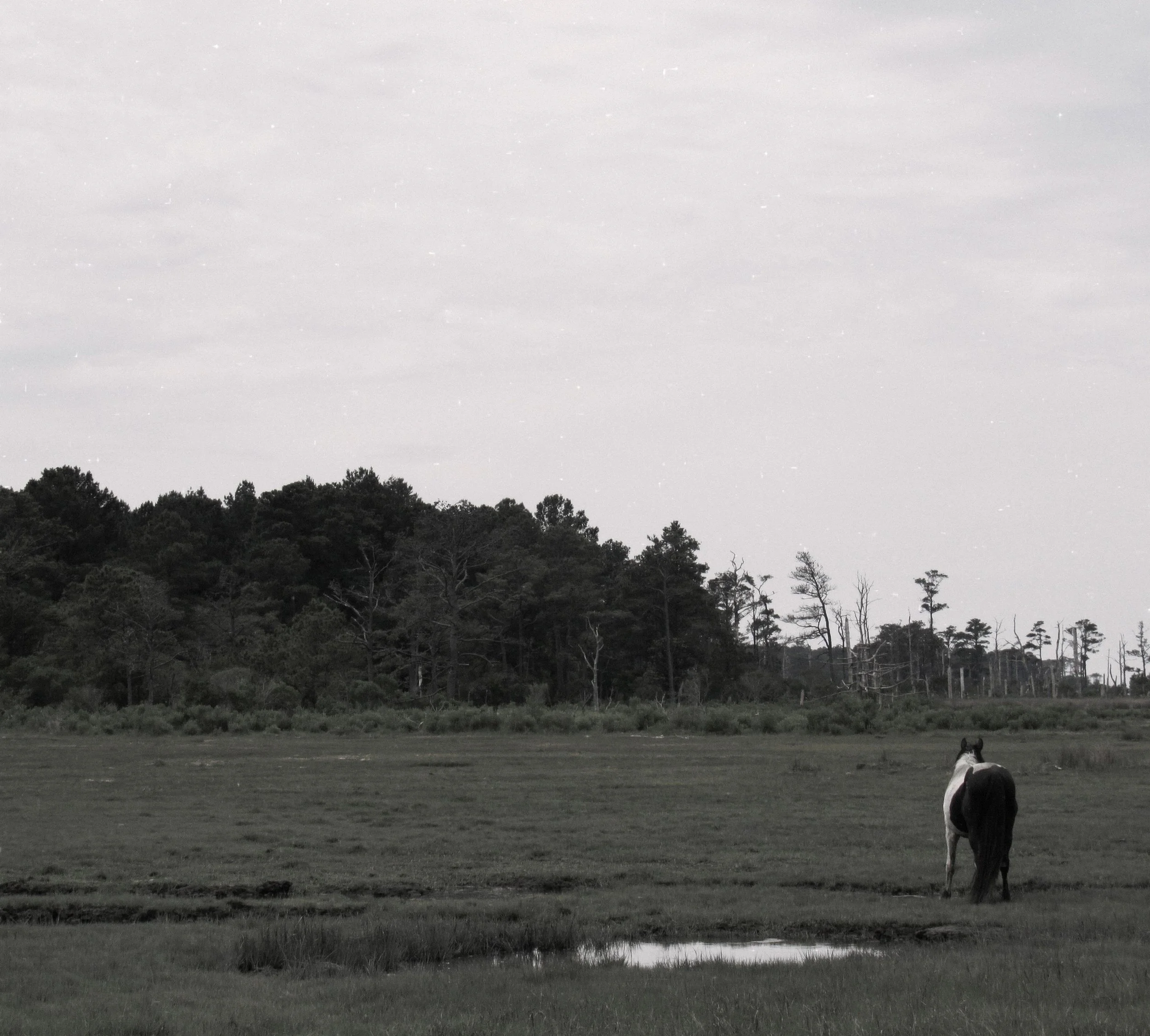
Back to the Band by Julianna Nelson-Gaudette
by Ainsley MacSlarrow
The Ocean Breathes Salt
The ground banked sharply to the left with a gurgling like a laughing toddler. The vibration jarred Emma’s knees, and her armload of spoons sprinkled across the wood.
“Careful,” warned Mrs. Marsdatter. The elderly cook hunched over potatoes. The open-air kitchen scented the wind with onion, herring, bread, and of course, stewing potatoes. The aroma was a reminder that the salty root vegetable was actively saving their country from starving.
Emma gathered the spoons. Rubbing them clean on her shawl, she fed them stick-side-down into a deep mug and blew any missed bits of dust from the wood.
Mrs. Marsdatter gave the potatoes one last brisk stir. “Go tell the boys supper’s ready.”
Emma nodded, hefting her skirt around her knees as she hurried away. The bracing September air blew her brown hair into a twist behind her head. A hazy layer of cloud blurred the moon and stars.
“Supper!” Emma called loudly to the men who were working nearby. Mrs. Marsdatter always referred to them as “boys,” though several were deep into middle age. Emma hurried down the rugged wooden stairs to shout at the rest of the crew.
Very quickly, a boisterous line formed as men shoved to accept a bowl and crust from Mrs. Marsdatter. Emma secured three meals and headed to the captain’s quarters.
Captain Magnesen, Lieutenant Bredesen, and the surgeon were deep in conversation when she entered, but they paused to look hungrily at their supper.
Lieutenant Bredesen patted his generous paunch appreciatively, like a walrus. “I heard you were engaged to that fellow apprenticed to the blacksmith,” he remarked to Emma. “Would I be right to think a wedding is on the horizon?” He winked.
There was an instant of deep silence. Emma unfolded and refolded a cloth napkin before placing it beside the surgeon’s plate.
“Jon Trofast drowned while fishing,” the captain said. “Emma will continue helping my wife with household chores in exchange for food and shelter until a better situation should arise.”
“Very sorry to hear that.” Bredesen took a gulp of water. “My deepest condolences.”
The table was nearly finished. “Thank you, Emma,” the captain said as she arranged the last fork. “Would you please tell Mrs. Marsdatter that my shoes need polishing?”
She nodded and scurried away. For supper, Emma found an unoccupied corner on the upper deck where she could sit cross-legged on the planks, looking out over the open ocean and sinking sun.
Girls were forbidden on ships, but an exception was often made for the captain’s wife so she could care for the crew. This time, an exception was made for Emma as well. The merchant vessel was returning home after visiting nearby islands to trade fish for coal and oil. Emma hated life on board the ship. The salty air stung like fishbones puncturing her throat, and she missed Jon. Her situation with Mrs. Marsdatter was supposed to be temporary; Emma had needed someplace to live while Jon finished his apprenticeship and saved enough money to marry her. Emma would have preferred to stay with Mrs. Darrisdotter, who housed her during her teenage years and whose six children Emma helped raise. Emma had been orphaned at three years old when her parents perished from sickness, and Mrs. Darrisdotter had seemed, if not motherly, almost like an aunt. But Mrs. Darrisdotter’s husband was struggling because of the war, as they all were, and he couldn’t continue to feed an extra mouth.
She closed her eyes and felt cold rock beneath her knees, fading light burning gently on her face, the comforting mass of hills rising behind her. Everything else vanished, and in her ear, Jon said quietly, shut everything out and breathe. She inhaled sun-warmed grass, weathered cliffs, salt, and stewed potatoes. She exhaled the tension knotted in her shoulders, the frustration flaring in the unoccupied corners of her brain. Whether we marry or not, I love you, Emma.
She breathed in again, then out, and out went the pressure of being shipped around the village like a sack of flour, of being the orphan everybody willingly took in but nobody wanted to keep. She breathed out the pain of having found somebody who wanted her yet didn’t have the means to keep her. The stewed potatoes settled wetly in her stomach. She rose and arced around the mast toward the kitchen, bowl clutched in her hand, nose stuffed with a bitter salt.
...
The sinking sun cast a dull yellow light across the sky. The clouds glowed as if hundreds of fireflies burned steadily underneath their loose, gauzy flesh. The glow made the veins in Jon Trofast’s wrist look strangely vivid. Far below, so distant the blue appeared gray, the ocean was completely smooth. He made out thirteen foaming caps and four elliptical dots that could have been boats. Above, the stars emerged starkly from the blackness of space, too many to count–the highest he’d achieved was four thousand three hundred eleven.
Jon watched a bird dive suddenly. It rose again, triumphantly, something shining wetly in its beak. A bright flash of scarlet caught the sun, and he imagined a redfish squirming helplessly in the grip of the larger predator. He wished he could reach down and release the fiery creature and return it safely to the ocean. But only a few meters below the cloud he sat on, his hands met an unshakable, invisible floor. He had traveled across the world, climbing over the clouds as though they were stepping stones, and everywhere he went the boundary below remained unpassable. He was powerless here. Traveling upwards was another matter: after pressing through light and heat, then blackness and suffocation, there were places to rest. Despite this, he’d invariably found himself returning here, watching the Arctic Ocean slowly fade from dark blue to light dawn gray. Watching the island he’d once called home flicker with lanterns, counting the foaming waves, counting the oval dots which heaved steadily across the sea. Breathing out, he leaned his weight into the soft cloud and counted the seconds.
...
The line where the ocean’s knees met the rumpled sky was interrupted by a camel shape the size of a large ship. During her breaks, Emma watched the camel grow steadily larger until she could recognize the distinct peaks of the two humps on its back.
It seemed the island would pass them on the left. The crew pulled ropes and pulled the wheel, yelling at each other. Slowly, the ship heaved back on course, Camel Island dead ahead.
About the same time as Emma began to distinguish the silhouettes of moored boats in the bay, a grating noise punctured her ears like a volley of sharp mineral crystals. A chorus of voices were singing a wordless hymn.
Footsteps suddenly thundered past her, and there was a splash: one of the sailors was flailing in the frigid ocean. Emma shouted. She rotated over the railing, shoes gripping the ship’s edge, prepared to leap in and help. The man’s entire body loosened. His neck relaxed so that his head rolled to face the sky, and he sank effortlessly beneath the waves. He didn’t resurface.
Emma screamed, and footsteps gravitated toward her, but she beamed her gaze in the direction of the singing. Squatting leisurely on a jagged line of rocks a few yards from the coastline, a dozen half-bird, half-human creatures were harmonizing with open mouths tipped to the sun. Emma could spot every droplet of seawater sparkling on their shiny taloned feet.
There were a volley of splashes as more sailors flung themselves into the sea. Emma cried out. Without pausing to think, she revolved back over the rail onto the ship and pitched herself at a man barreling recklessly toward the edge, forcing him to the floor. He fought her with punches and knees and shoves, but she circled her arms around his neck. Gasping from the pressure on his windpipe, his thrashing became sluggish; a minute later, he collapsed limply. Emma caught her breath.
After a moment, she crawled to her feet. The ship was the scene of a pub after a brawl: toppled barrels rolled in every direction, ropes were scattered, and the man she’d rendered unconscious was not the only sailor lying on the deck. Trygg, a seaman who could usually be seen climbing the masts, was knotting a thick rope around the wrists and ankles of the captain, who was sprawled inertly near the wheel. Trygg felt Emma’s gaze and raised his head.
“Sirens,” the sailor said, jerking his head toward the singing people perched on rocks. “Their voices and beautiful appearance drive most humans mad, cause us to drown ourselves. We lost more than half the crew.” He tightened the last knot around the captain’s thumbs, then moved to restrain the other two sailors he’d dazed.
“Do you think anyone else…?” Emma felt winded. The crew had comprised eleven men including the captain, plus Mrs. Marsdatter. Had only four of them survived?
“Search the ship,” Trygg ordered. He finished tying up the man Emma had driven senseless and began dragging the bound men toward the steadier center of the ship.
Emma forged below deck. She had never noticed before how sour and dank the air smelled. It felt wet on her tongue. She lit the first lantern she found and raised it above her head like a beacon, scanning the forecastle and captain’s quarters. Finally, in the hold, her light fell upon a terrified boy crouching behind a barrel of coal. Emma’s racing heart slowed. He was the apprentice. She thought his name was Jeremias; he often helped her scrub the deck. She sank to the floor beside him.
He looked at her with wide eyes. His hands were clamped over his ears. “Are they gone?”
Emma could still hear the singing through the sloshing of the ocean against the sides of the ship. She shook her head. Putting the lamp aside, Emma reached inside her pocket and drew out a cotton handkerchief. She vainly attempted to rip it for several seconds before the boy gave her his pocketknife, and she sliced the cloth neatly into two strips. Bundling the strips into balls, she held them out to him, miming putting them in her ears. His face lit up as he understood; taking the fabric, he stuffed them unceremoniously into his ear canals, wincing in the few seconds his uncovered ears were vulnerable to the singing.
Emma pushed herself to her feet, then paused. Name? she mouthed, pointing to his chest.
“Jeremia,” he said. She’d been close.
Gesturing for him to follow, Emma carried the lantern up the stairs and out onto the deck. Like damp steam from a suddenly unstoppered kettle, the singing broke over her; she glanced at Jeremia, but the cloth in his ears seemed to block the worst of the noise. Trygg stood at the foot of the main sail, the incapacitated seamen leaning uncomfortably against the mast. The sailors’ ears were plugged with cotton, and they were roused and seemed in full awareness of their wits.
“There you are,” Trygg said upon seeing Jeremia. Despite his gruff tone, his weathered face registered relief.
The captain coughed. A bulbous red lump rose on his forehead where he’d been struck by Trygg, and his normally commanding body looked strange wrapped helplessly in ropes. “Did anybody else survive?”
Emma lowered her gaze. She shook her head, then glanced at Trygg. “I don’t understand why Mrs. Marsdatter is gone. The sirens must have lured her somehow, but she’s a woman…”
“Sirens attract more than just men,” Trygg said.
“Then why am I unaffected?”
Trygg paused. “I have a wife at home, my sun, moon, stars, and sky. The sirens have no hope of ever becoming as beautiful as she is in my mind, or of singing as sweetly as she calls my name.” He gestured at Jeremia. “I assume he also has a romantic interest. The captain loved his wife exceedingly. When we are truly in love,” Trygg said, “the sirens cannot tempt us.”
Emma thought of Jon, of his face, his shoulders, his voice. Then she thought of the smooth grave in the churchyard surrounded by blue sea hollies.
The captain coughed again. His facial expression contorted with warring emotions, but duty and training triumphed. “Let go the anchor,” he ordered. “We remain here tonight.”
Emma absorbed this. She could feel the salt air at the back of her throat, pressing on her air pipe. When Trygg returned from casting the anchor, she said, “What do we do now?”
The captain couldn’t hear through the cotton in his ears, but he read her lips. “We sleep,” he said. “Drag us to the hold and tie us to barrels of sugar. Tomorrow, we reconvene.”
Emma was last to descend belowdecks. She stared across the dark water at the island, imagining she could make out the village, the beach, a bobbing lantern clutched tightly in Jon’s hand. The shadows curled into sunlight flashing on the church’s cross, a wooden casket, an abandoned bucket filled with dead herring and two inches of rotting ocean water weighting Jon’s back porch for over a week until the neighbor took pity. She shut her eyes and tried to inhale the scent of grass, freshly baked bread seeping from the bakery. Her breath caught in her throat. Her knees felt muddy with fear. The ship bobbed beneath her feet. She couldn’t escape, not even through imagination; the constant high-pitched singing of the sirens trapped her in reality. Emma made one last futile effort to draw a full breath, then hurried down to the hold.
...
The moon smoothed the surface of the water, dappled it with silver, painted opaque shapes that shimmered with wind. The darkness fell slowly. Three white rectangles hovered above the surface of the ocean. When the sun vanished, the stars became too bright to look at, so instead he watched the rectangular sails rustle in motionless air. The colors of the sirens’ song stained them, red and purple and blue and red, making it impossible to look away. The smell of fear, like rotting herring, wafted from the ship. One image in his mind was so strong he could almost see it: his Emma standing on the edge of the deck, holding in her palm a single bead of flame.
...
Camel island blurred with the horizon, and Emma’s gaze was drawn instead to the glassy ocean surface. Her skirts barely twitched in the still air.
An examination revealed they had barely enough food and water to last the small crew three days on reduced rations. They had packed sparingly to begin with, and the journey had taken four days longer than hoped, and the sirens blocked their only way home. Lieutenant Bredesen, who was among those Trygg saved from the siren song, predicted the nearest island was a two-and-a-half-day journey away. The captain decided they would sail there, restock, then return home.
When Trygg voiced concern at leaving their island while it was so vulnerable, Captain Magnesen did not respond. They all understood: there was no choice. Besides, with or without food, the ragged crew couldn’t offer much help to their island.
The siren song slowly faded as they sailed beyond earshot; by midday, it lingered only as a tender memory. Emma hovered at the stern, fingers ringing the taffrail. She closed her eyes.
Beneath her feet, the ground seemed to steady, and she felt the jagged edges of beached seashells shredding the soft soles of her feet like potatoes. A cool, grassy breeze brushed through the roots of her scalp: she inhaled sand, soil, and only the slightest hint of salt. Her shoulder sank at an imagined soft pressure of Jon’s hand. The sound of his voice entered her mind, no words, just the voice, and it eclipsed the echo of the siren song. It anchored her soul. Emma exhaled the hot air of the hold, the rustling of sails, the shouting of sailors. She breathed in sweet yarrow. The wetness on her cheek dropped to meet the ocean. She curved her hands across her shoulders, elbows pressed into the cold rail, and she met the horizon with a dragon’s breath.
by Solomon Bradley
Bonsai Body
It is time for the feeding.
Lumps of wrongthinkers
And mathtalkers bleeding,
Rotting at our feet.
It is time for the burning.
Flatscreens of fire,
Five in number,
Semicircle of blaring sunhate.
Our rightmost tendrils
Metastasize,
Engulf the heart,
Funnel the nectar
The nectar
It is time for the drinking.
Halfcleaned sewage slops through branches,
Glides into scar-rimmed incisions
Where the trunk-bodies drink.
It is time for the trimming.
We do not scream.
We do not cry.
We are the leftovers
Of the hollow men.
We are the meat
Scraped away
To make room
For capital.
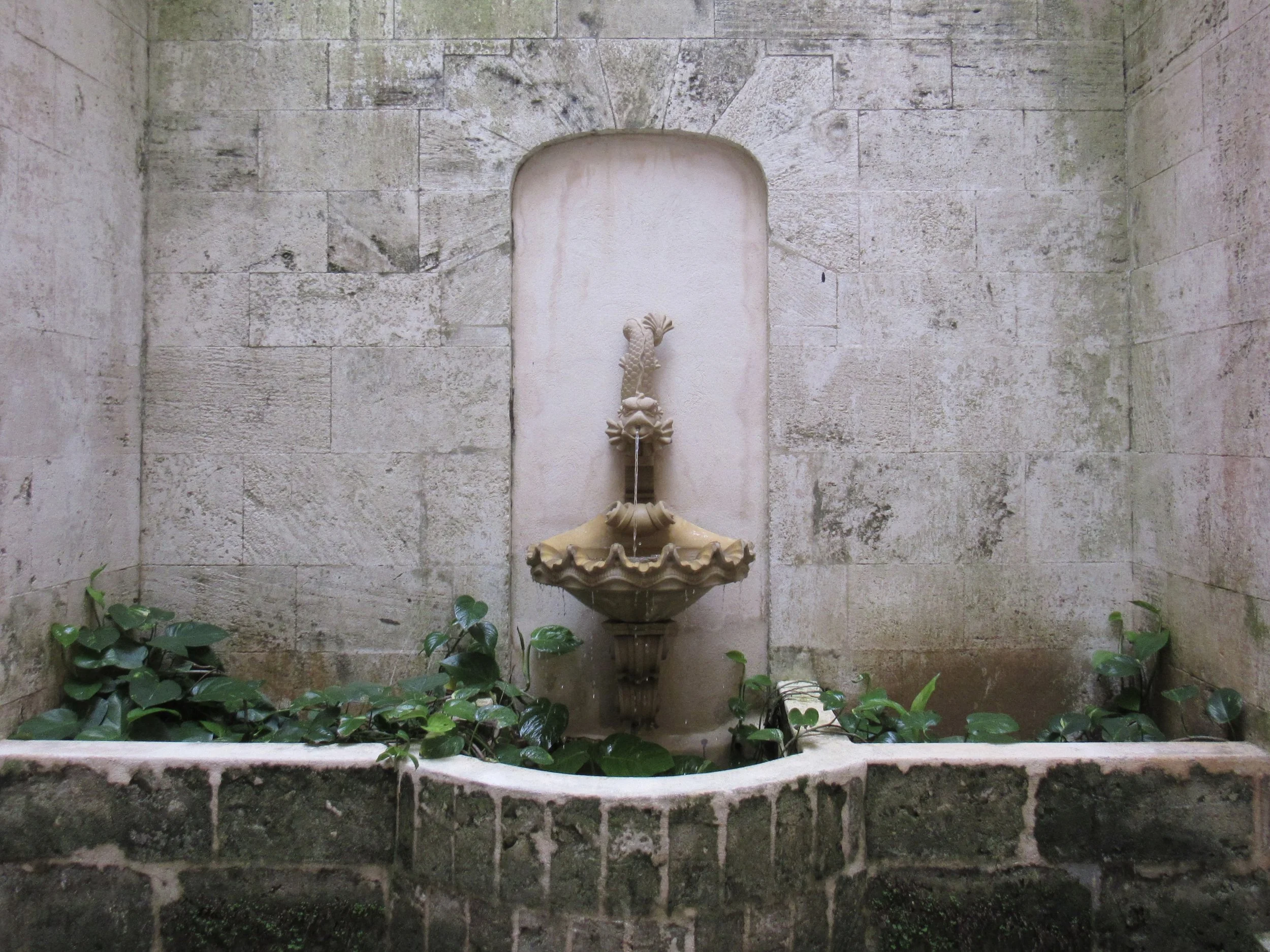
Sleepy at the Governor’s House by Julianna Nelson-Gaudette
by Maria McGinnity
I Stand Before You Delirious
The red bloom flooded
And I was inverted. Perverse,
It knocked me
Perpendicular to the
Banality of the before.
Words writhe in fresh
Air, having settled in the folds
Of my mind. You spoke
To me once; there is something
Unsettling in the ecstasy
Of sound.
I trade my sense for terms
Of endearment, forgetting
Ghosts have no ears.
How lucky are we
For the time we traveled through together.
by Sophia Liggett
For Saul
I’m just calling to tell you that I still don’t like the summer here
but I hate it less each time I wake up next to the three-foot-tall silk gladiolus
I bought for ten dollars at the Michael’s just off the worst road in America,
where I once watched a motorcyclist with his hands raised as if in rapturous prayer
trace the path of a rolled coin, swaying across the left lane. I’m talking to you
instead of writing the eulogy my dad wants my help correcting before he delivers it.
He is attending a funeral and a wedding within five days of each other.
And your wife had her baby. I think we are living. It occurs to me every time
I get gas—that I have done enough living to put a dent in twenty gallons and 300,000 miles
and one SUV with the dealer tags still on in the parking lot of a brewery where I was meant
to be serving sandwiches to drunk trivia contestants. Last night after the thunderstorms
my stairs were slick and I was carrying an umbrella and a drink and a phone
and thinking about calling and I hit my knee so hard I bruised a relief
of the gap between two boards directly into my skin. I wanted to cry for the shock
but my body knew it was meant to be laughing instead. Your daughter looks
like a rotisserie chicken in the second picture you sent, with her ankles crossed
and her mouth open, mid-wail, and I thought of her first breath while I knelt
on the landing, spokes of my umbrella poking my cheek— I’ve been told
that it’s vitally important babies shriek the liquid from their lungs as soon as they’re born,
and a girl I know wrote a poem that told me the truest pronunciation of YHWH is a breath.
She said that everyone’s first word is the name of God. But I say, at least two people
in the world were terribly aware last night that surely no one breaks for God
until the screaming is done. Tell the girls that someone in South Carolina loves them
even though we’ve never met and even if it’s just because they love you.
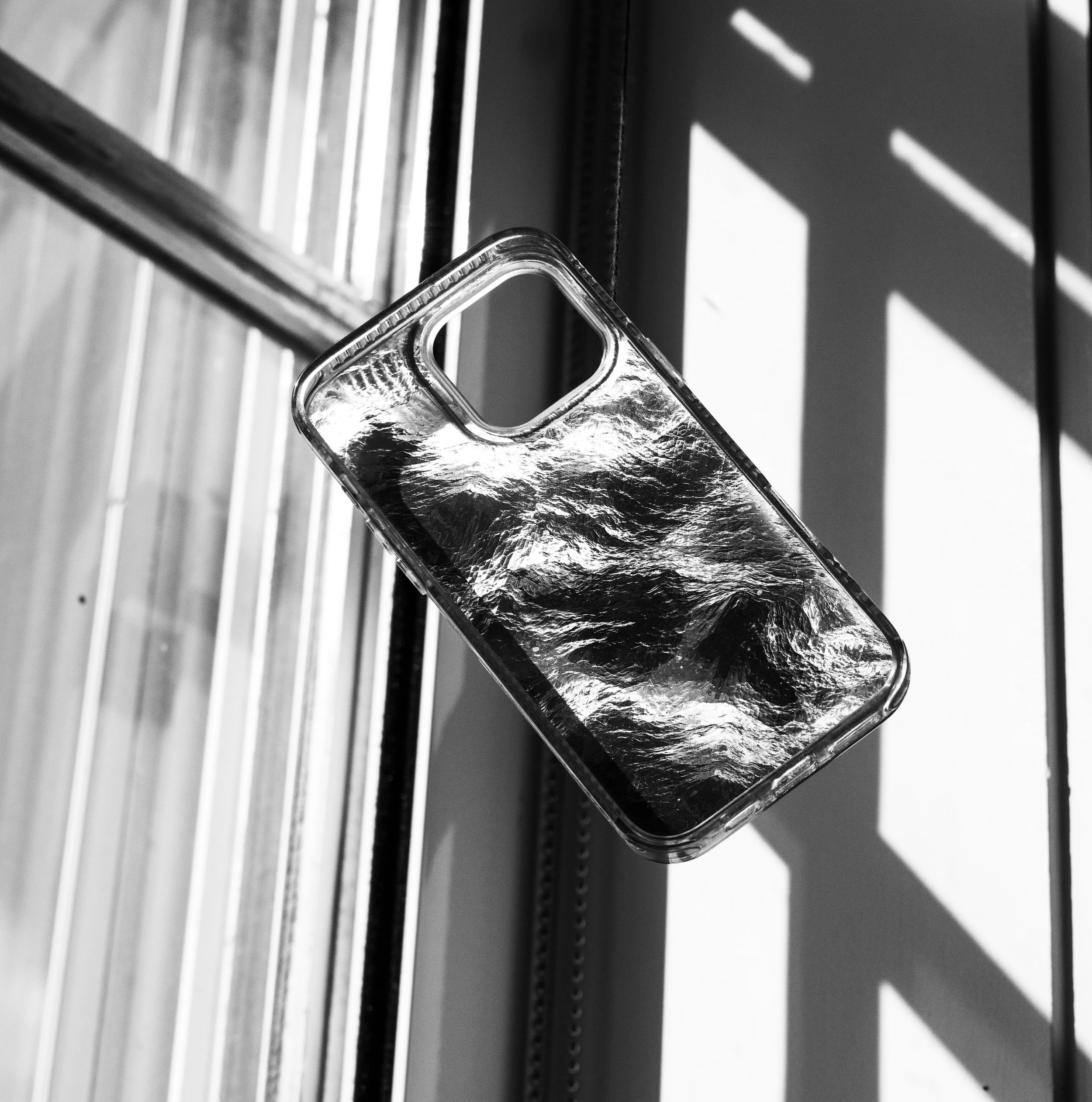
Disconnect by Ethan Ransom
by Sophia Liggett
Hawk Landing
Sunday morning, I am crouching on a flat stone;
it is finally spring in your downtown garden.
You forgive or do not notice
my tactless hands, trembling marginally,
too much to be trusted with your china,
coffee, daughter. And when I cannot look
anyone in the eye, I map generations
of warfare across the back lawn,
between death-pale loam and grass.
The color of absinthe, alive in spurts,
losing. I want something horrible
from you. I want a life
between my clumsy fingers,
and yes, for a moment I want the crater
left when I pluck an innocent battalion
from your yard—tell me I have taken a life
for my own. You offer your saucer
to a terrorist, your silver carafe, pallet of raspberries
sweat-slicked. You walk me to my car
under the dappling, branching shade
of your fig trees, your million
choices. You slip my love back
in my jacket pocket, hug me goodbye—
and coming home, you dissolve
into the wildflower medians
and you stay there.